
AI Automation for Small Business: Fix These 5 Operational Bottlenecks First
Dede Barbanti
AI & Automation Strategist | Founder, Bizipro
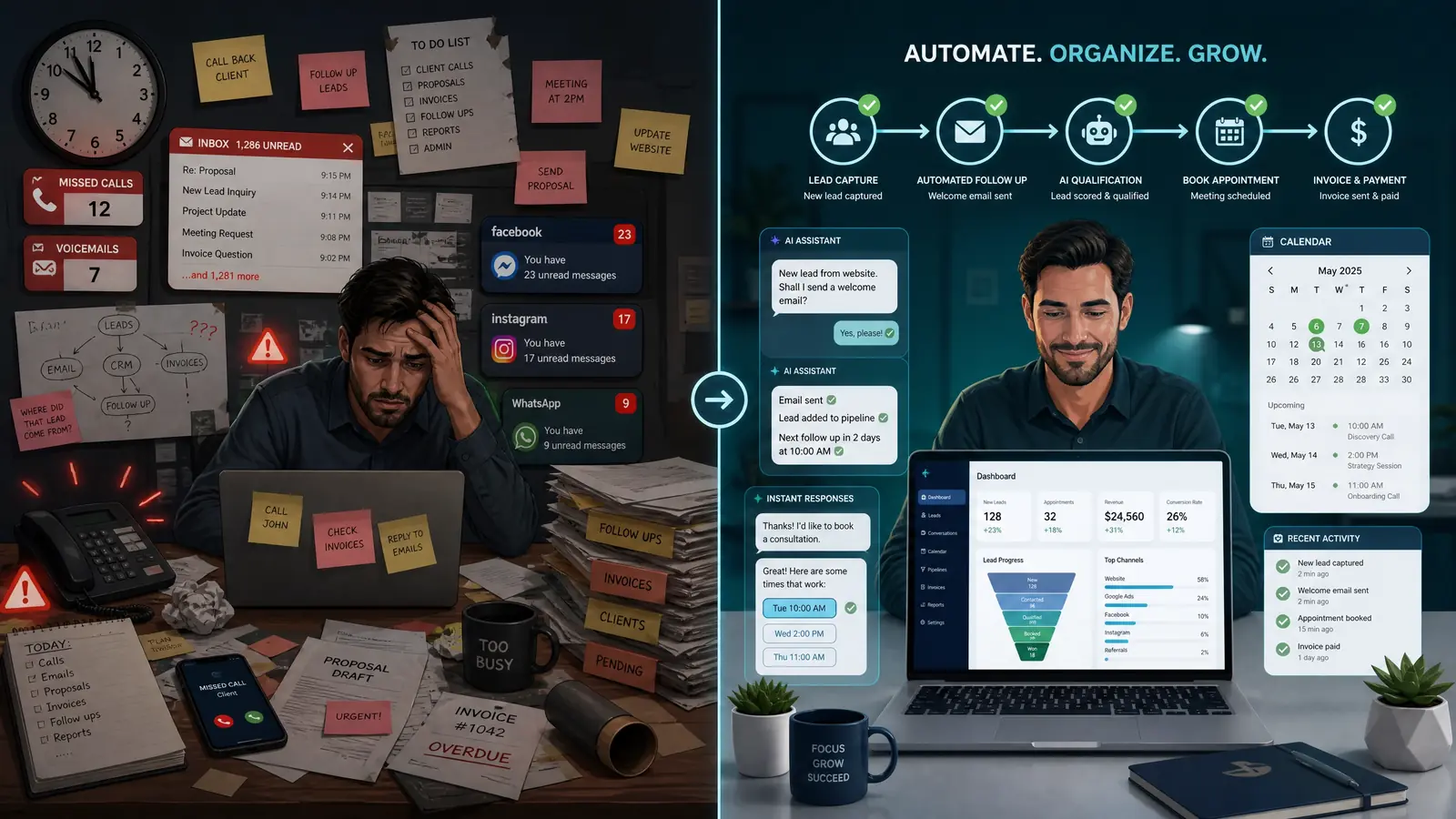
Right now, business owners are being hit from every direction with the same message: you need AI.
AI for follow-up. AI for scheduling. AI for customer service. AI for sales. AI for operations.
The problem is not that AI is useless. The problem is that too many businesses are trying to add AI on top of broken workflows, scattered communication, inconsistent follow-up, and manual processes that were already costing them time and money long before AI became the latest thing everyone started talking about.
That is where a lot of business owners get frustrated. They buy a new tool, test a chatbot, sign up for an automation platform, or try some new AI solution, and nothing really changes. Leads still fall through the cracks. Staff is still buried in admin work. Missed calls still go nowhere. Follow-up is still inconsistent. Customers still wait too long for answers. The business still feels reactive instead of streamlined.
AI is not the strategy. It is just one part of the solution.
The truth is, AI automation for small business works best when it is used to solve real operational bottlenecks, not layered on top of messy workflows and inconsistent processes. If the underlying process is disorganized, unclear, or dependent on people remembering to do everything manually, AI is not going to magically fix it. In a lot of cases, it just makes the chaos happen faster.
Before a business adds AI, the smarter move is to look at where the operational bottlenecks actually are. Once those are identified, then you can decide what needs to be tightened up, what should be systemized, and what makes sense to automate.
Here are the first five bottlenecks I would look at before implementing AI into a small business.
Slow lead response and inconsistent follow-up
This is one of the biggest revenue leaks in small business, and it shows up in almost every industry.
A lead comes in through the website, social media, a referral, text, or a phone call. Maybe someone on the team responds quickly. Maybe they do not. Maybe they mean to follow up later and forget. Maybe they answer the first inquiry but never stay consistent after that. Maybe the business owner is the one handling everything, which means response time depends entirely on how overloaded they are that day.
By the time someone circles back, the lead has already gone cold or reached out to someone else.
A lot of businesses think they have a lead generation problem when what they really have is a lead handling problem.
BEFORE ADDING AI, ASK:
- How quickly are new leads being contacted right now?
- What happens if an inquiry comes in after hours?
- What happens if no one answers the phone?
- Is there a consistent follow-up process after the first contact?
- How many touches happen before a lead is considered dead?
- Is anyone tracking where leads are dropping off?
If those answers are unclear, that is the first problem to solve. AI can absolutely help with lead response and follow-up, but only after the business has a clear workflow for what should happen from the moment a lead comes in to the moment that lead books, buys, or exits the pipeline.
Missed calls with no recovery process
A missed call is often a missed opportunity, especially for service-based businesses.
One of the most common breakdowns I see is simple. The phone rings, nobody answers, no one calls the person back, and there is no immediate text or follow-up process to catch that lead while they are still actively looking for help.
Most prospects are not sitting around waiting for a callback. They are calling the next company.
BEFORE ADDING AI, ASK:
- What happens when a call comes in and nobody answers?
- Is there an automatic text-back or follow-up process?
- Does someone get notified to call the person back?
- Are missed calls being tracked anywhere?
- How many opportunities are being lost simply because there is no system behind unanswered calls?
This is one of the fastest areas to improve because it usually does not require reinventing the business. It requires building a better response system. AI and automation can absolutely support missed-call recovery, but the real issue is not the tool. The issue is whether the business has acknowledged that missed calls need their own workflow instead of being treated like random loose ends.
Scheduling friction and too much manual back-and-forth
Another major bottleneck is the amount of time businesses waste trying to coordinate appointments, consultations, follow-ups, estimates, or onboarding calls.
Someone reaches out. A team member responds. The customer asks what times are available. The team checks the calendar. The customer cannot do those times. The team sends more options. Then someone forgets to confirm. Then the appointment gets missed because no reminders were sent.
This kind of friction adds up quickly. It slows down conversion, creates a poor customer experience, and eats up time that staff could be using on higher-value work.
BEFORE ADDING AI, ASK:
- How are appointments currently being booked?
- Is the calendar connected to the intake process?
- Are confirmations and reminders being sent automatically?
- Is there a reschedule and cancellation process?
- Are no-shows being tracked or followed up with?
- How much staff time is being spent manually coordinating availability?
If the answer is "a lot," then the business probably does not need more people yet. It needs a better scheduling system. AI can make scheduling smoother, but only if the business has already decided how appointments should be handled, who gets booked where, what availability rules matter, and what communication should happen before and after the booking.
Scattered customer communication across too many places
This is a big one. In a lot of small businesses, communication is happening everywhere at once: text messages on someone's cell phone, emails in multiple inboxes, website forms, social media DMs, voicemails, sticky notes, call logs, spreadsheets, and random reminders in someone's head.
That is not a system. That is a liability.
When communication is scattered, things get missed. Messages do not get answered. Team members duplicate work. Nobody has a clean view of the customer journey. The owner cannot tell what happened, who responded, or where the lead stands. Follow-up becomes inconsistent because there is no central place to manage it.
BEFORE ADDING AI, ASK:
- Where are customer and lead conversations currently happening?
- Is there one central place where communication is tracked?
- Can the team see the full history of a lead or client interaction?
- Are messages being assigned or routed clearly?
- Is anyone relying on memory or personal inboxes to manage customer communication?
If the communication layer is a mess, AI should not be the first conversation. The first conversation should be about centralizing the workflow and creating visibility. Once that foundation is in place, AI can help with response speed, routing, reminders, qualification, FAQs, and follow-up. But without that foundation, it often just creates one more disconnected layer.
No clear workflow from inquiry to client to post-service follow-up
This is where a lot of businesses lose money without even realizing it.
A lead comes in. Maybe someone responds. Maybe they book. Maybe they become a customer. But after that, there is no consistent system for what happens next. No onboarding sequence. No internal handoff. No task triggers. No follow-up reminders. No review request. No check-in after the job is done. No reactivation process months later. No clear ownership of the next step.
The business is running transaction to transaction instead of through a repeatable workflow.
BEFORE ADDING AI, ASK:
- What happens the moment a lead comes in?
- What happens after the first response?
- What happens when they book?
- What happens when they become a client?
- What happens after the service is completed?
- Where are internal tasks triggered?
- Who owns each stage?
- What is automated and what is still manual?
- Where do clients, customers, or opportunities fall off?
If there is no documented workflow from inquiry through post-service follow-up, then AI is being introduced into a moving target. That is one of the biggest reasons AI projects fail. The business is asking the tool to solve a process problem that has never actually been defined.
Where AI automation for small business actually helps
This is the part a lot of business owners need to hear. AI automation for small business can be extremely valuable, but not because it sounds impressive or because everyone else is talking about it. It is valuable when it is aimed at the right parts of the business.
In most small businesses, that usually means using AI and automation to support areas like:
- Lead response and follow-up
- Missed-call text back and call recovery
- Appointment scheduling and reminders
- Repetitive customer communication
- Intake and qualification
- Internal task reminders and handoffs
- Post-service follow-up and review requests
- Reactivation of old leads or past customers
Those are the kinds of tasks that slow teams down when they are handled manually and inconsistently. They are also the areas where a well-built system can create faster response times, better customer experience, and fewer opportunities falling through the cracks.
The key is that AI should be supporting a clear workflow, not trying to replace the need for one.
AI is powerful, but only when it is built on top of a real operating system
AI can absolutely improve response times, follow-up, scheduling, communication, task management, lead qualification, and customer experience. But the best results happen when AI is built into a business with clear workflows, clean handoffs, connected systems, and a real strategy behind what should be automated.
The goal is not to add AI because everyone is talking about AI. The goal is to remove operational drag. That might mean:
- Tightening up how leads are routed and followed up with
- Building a missed-call recovery process
- Reducing scheduling friction
- Centralizing communication
- Creating a clear client journey with defined next steps
- Identifying which repetitive tasks should be handled by automation versus by a person
Once that is clear, AI becomes much more valuable because it is supporting a system instead of being expected to invent one.
Where I would start if I were auditing a business for AI and automation
If I were evaluating a business to see where AI and automation could actually help, I would not start by asking what AI tool they want. I would start with questions like:
BEFORE ADDING AI, ASK:
- Where are leads being lost right now?
- Where is response time too slow?
- What repetitive communication is eating up staff time?
- What happens when someone calls and nobody answers?
- Where does scheduling break down?
- What parts of the customer journey rely too heavily on memory or manual effort?
- Which internal tasks happen over and over but still depend on someone remembering to do them?
- What would make the biggest difference if it happened faster, more consistently, and with less manual effort?
Those answers tell you where AI belongs.
Final thoughts
Most businesses do not need more tools just because the market is shouting about AI. They need fewer bottlenecks, better systems, and a smarter way to handle the repetitive communication and workflow tasks that slow the business down.
If your business has slow lead response, missed calls with no recovery process, scheduling friction, scattered communication, or no clear workflow from inquiry to follow-up, those are the first problems to fix.
Then, and only then, should you decide where AI and automation fit.
Because the right AI strategy is not about doing what is trendy. It is about fixing what is costing your business time, money, and consistency in the first place.
If you are looking at AI automation for your small business but are not sure where to start, the first step is not buying another tool. It is identifying where leads, time, and communication are being lost in your current workflow. That is where the right automation strategy begins.